
Compare Leake County Property Value Types
Mississippi assessment records and Leake County deed records each use value language for their own purposes. Keep the assessor's figures apart from transaction evidence before comparing anything. No single figure here stands in for a current private appraisal.
| Value Type | What It Means | Where It Is Recorded |
|---|---|---|
| True value | The assessor's full-value basis under state rules | Assessment record |
| Assessed value | True value multiplied by the class ratio | Assessment record |
| Taxable amount | The figure after applicable exemption treatment | Tax and homestead records |
| Recorded consideration | An amount stated or indexed for one conveyance | Deed or Chancery index |
Assessed value exists to support taxation. Recorded consideration documents one deed instrument. A market appraisal estimates worth for a stated date and purpose. Compare like with like, and note the year and property scope tied to each number.
Apply Mississippi Ratios to Leake County Assessed Value
The Mississippi Department of Revenue appraisal guidance sets a 10 percent assessment ratio for Class I owner-occupied residential real property. It sets 15 percent for Class II real property. The arithmetic is simple: true value multiplied by the verified class ratio yields assessed value. Always check classification first. Either percentage misleads without it.
The calculation explains a label, nothing more. The product becomes the assessed base before millage and exemption treatment apply. It cannot tell you whether the assessor's true value matches a likely sale price.
- True value
- The full-value basis in the state assessment system.
- Assessed value
- True value after the proper class ratio.
- Assessment ratio
- The statutory percentage tied to property class.
- Reassessment
- A periodic review of real-property values.
Classification is part of the math, not a guess you make from a building's looks. Verify the class shown in the assessment source. Check the property's qualifying use too, before applying the 10 or 15 percent ratio. One parcel may hold several interests or uses. Never invent a blended ratio the official record does not show. Record true value, class, ratio, assessed value, and effective year as separate fields.
The ratio also explains why a smaller assessed number is not a bargain. It is a statutory step in Mississippi's tax system. Weighing an assessed amount against deed consideration yields a misleading percentage. That happens when you fail to restore both to the same basis and date. Use the ratio to understand the assessment record, not to reverse-engineer a promised market result.
Estimate the Recorded Leake County Property Value
Start with the county property search to locate the assessment account. Check the effective year and class before reading any value. Delta accepts address, name, parcel number, section-township-range, and PPIN. Rural tracts usually match better by parcel key than by a modern mailing label.
- Find the parcel in Delta and copy its PPIN or parcel number.
- Read the displayed value, class, land or improvement details, and year when shown.
- Use the applicable state ratio to understand the assessed figure.
- Check Chancery deed consideration only as separate transaction evidence.
The result screen shows the actual fields for your parcel, and value components may or may not split into land and building lines. Read the live record itself rather than assuming a standard land-and-improvement breakdown.
Compare Leake County Values by Effective Year
Mississippi requires real property to be revalued at least once every four years. That rule sets a ceiling. It does not guarantee that a parcel changes only once per cycle. New construction, classification changes, corrections, and other assessment work can move a record between cycles.
The Tri-State Leake County hub carries an effective year label. It also links appraisal, millage, homestead, tax-sale, and map resources.
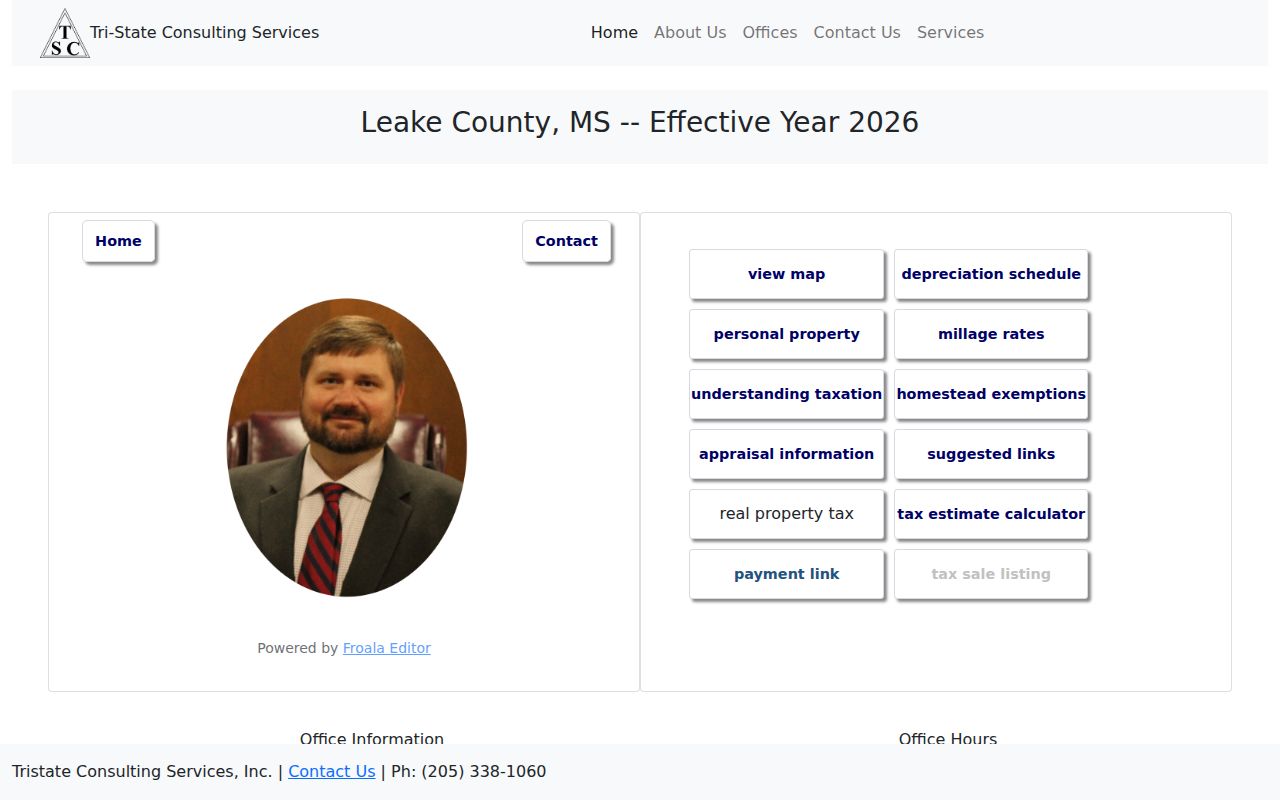
The year label is your cue to date every comparison instead of mixing assessment periods. It signals portal state, not proof that all historical values are online.
Note: A change between effective years may reflect assessment work, a property change, classification, or corrected data rather than a sale.
A four-year revaluation requirement sets the longest interval for reviewing real property. Records can still change between broad cycles. New improvements, removed improvements, acreage corrections, class changes, and corrected parcel data may all alter the assessment. Compare the land and improvement components when the live result provides them. Record what changed instead of crediting every difference to general appreciation or decline.
Date the effective-year hub at the time you use it. The Department of Revenue publishes historical county and city millage tables. These sources can anchor a year-specific comparison. They do not prove the portal preserves every past parcel card, though. Older assessment questions may call for the Assessor/Collector, a public-record request, MDAH assessment materials, or tax rolls held in another documented collection.
Compare Leake County Sale Consideration Carefully
The Leake Chancery DuProcess index lists consideration among its instrument criteria. That recorded amount can hint at a transfer. Still, it means little without the deed type, the parties, the date, and the land description.
Estate distributions, partial interests, corrective instruments, related-party deeds, and multi-parcel conveyances in Leake County may all carry amounts. Those amounts can look nothing like an open-market sale.
Never treat an indexed figure as the last sale price until the document itself is read. A deed stating one number does not disprove the assessor's true value. The two figures come from different processes, different dates, and different property scopes. They answer different questions.
Before using consideration as a comparison point, confirm the deed covers the same parcel. Confirm it also covers the same interest. One instrument can convey several tracts. It can reserve mineral rights. It can correct an earlier deed, or move property within a family or an estate. The indexed figure may never allocate an amount to the single parcel being studied. Record the deed type, grantor, grantee, instrument date, recording date, consideration, and legal description together. That way, the transaction never loses its context.
When an image is missing, use the portal's notification option. Or contact the Chancery Clerk with the instrument number or book and page. An index field is only a finding aid. The official copy shows the terms that qualify the amount. That distinction keeps a property-value question anchored in what the number actually means. It stops one search result from standing in for an appraisal no one performed.
Separate Homestead From Leake County Property Value
Mississippi homestead law sits in Code §§27-33-1 through 27-33-79. The Department of Revenue publishes the January 1 through April 1 application window. It also posts tiered exemption details. An exemption shifts the taxable amount. It leaves true value and assessed value untouched.
Record exemption status separately whenever Leake County parcels are compared. Two properties with nearly identical assessments can produce different tax bills. That gap says nothing about market worth. The application and billing details belong with county tax records.
Understand What Millage Adds to Leake County Value
State guidance frames the tax relationship through true value, the assessment ratio, and millage. Millage turns an assessed base into a tax bill. It is not itself part of property value. The Department of Revenue publishes county and city millage tables covering 2012-2025, and the Tri-State hub links current local resources.
Municipal and school context shapes the bill too. A mailing ZIP never establishes a city boundary. Use the physical jurisdiction when reading a rate. This ground stops at how the numbers differ; delinquency, exemptions, and protest procedure belong in the property-tax record.
Keep millage out of any comparison of underlying value in Leake County. Two parcels with identical assessed amounts can carry different tax outcomes under different municipal or school levies, while two parcels with different true values can end up with similar bills once classification or exemptions apply. The tax result cannot be worked backward into a clean market estimate unless every piece of the official formula and the jurisdiction behind it is known.
Add Parcel Context to a Leake County Value Comparison
The ArcGIS viewer can confirm that two records actually concern the intended land. The statewide LEAKE_PARCELS layer 60 does the same. Parcel shape, location, road context, and visible improvements all guide the next step in a property search. But a GIS map is not an appraisal. Nor does it prove a legal boundary.
When nearby assessment entries are compared, align parcel class and acreage. Improvements, effective year, and municipal context matter too. A broad neighborhood scan without those controls can make unlike parcels look alike. For the actual figures, return to official assessment and deed records.
Know What Leake County Assessed Value Cannot Tell You
Assessed value serves the public tax system. It cannot predict a negotiated sale. It does not guarantee replacement cost, describe hidden defects, or replace a dated appraisal. Recorded consideration carries its own limits in Leake County. The instrument may cover a partial interest, several parcels, or a non-market transfer.
For buying or selling due diligence, compare official figures by date and scope. Inspect the actual conveyance. Obtain qualified valuation help whenever a decision needs a current market conclusion. A portal result is a documented starting point that another researcher can reproduce.
Value is not price. A Leake County assessed value supports taxation and is neither a promised sale price nor a licensed appraisal.