
Fields in Leake Tax Records
Leake County property tax records blend two streams of information. On the assessment side, the Assessor locates, classifies, and values taxable property, keeps ownership maps current, lists improvements, and helps owners file for homestead exemption. On the collection side, the Collector mails statements, receives payments, and runs the annual sale process for unpaid real property taxes and special assessments.
| Field | What It Shows | Where |
|---|---|---|
| True value | Appraisal basis before the class ratio | Assessor roll |
| Assessed value | True value after the state class ratio | Assessment record |
| Exemptions | Relief applied under state and local rules | Assessor |
| Tax bill and status | Amount due and payment status | Collector and Tri-State |
| Owner and parcel key | January 1 owner, PPIN or PARID | Tax statement |
Mississippi taxes with a simple formula. True value times the assessment ratio times millage produces the bill. A mill is a local levy expressed in mills. Exemptions can lower the taxable amount. None of these figures says what a buyer would actually pay for the property.
Leake Assessor and Collector
Both roles sit in one office at 219 W Main Street, Carthage, MS 39051. Its county department page lists 601-267-3021 and weekday hours from 8 a.m. to 5 p.m. Values and classes are Assessor questions. Balances, receipts, and sale status are Collector questions. Redemption after a tax sale, and tax deeds once they mature, also draw in the Chancery Clerk. So distressed-property work can cross both offices.
Leake Values and Class Ratios
Class ratios come from the state. The Mississippi Department of Revenue sets Class I single-family, owner-occupied residential real property at 10 percent of true value. Class II, all other real property, sits at 15 percent. Revaluation is required at least once every four years.
- True value
- The appraisal basis before the ratio.
- Assessment ratio
- The state percentage for a property class.
- Assessed value
- True value after the ratio.
- Millage
- The levy that turns assessed value into tax.
These Leake County property tax values exist for taxation only. A sale price, a private appraisal, and an assessed value can all differ, because each one measures something different.
Leake Tax Hub for 2026
The Tri-State county hub carries an effective year of 2026. It links appraisal information, millage, homestead details, tax sale material, and the parcel map. That year marks the portal's cycle, not the online depth of every field.
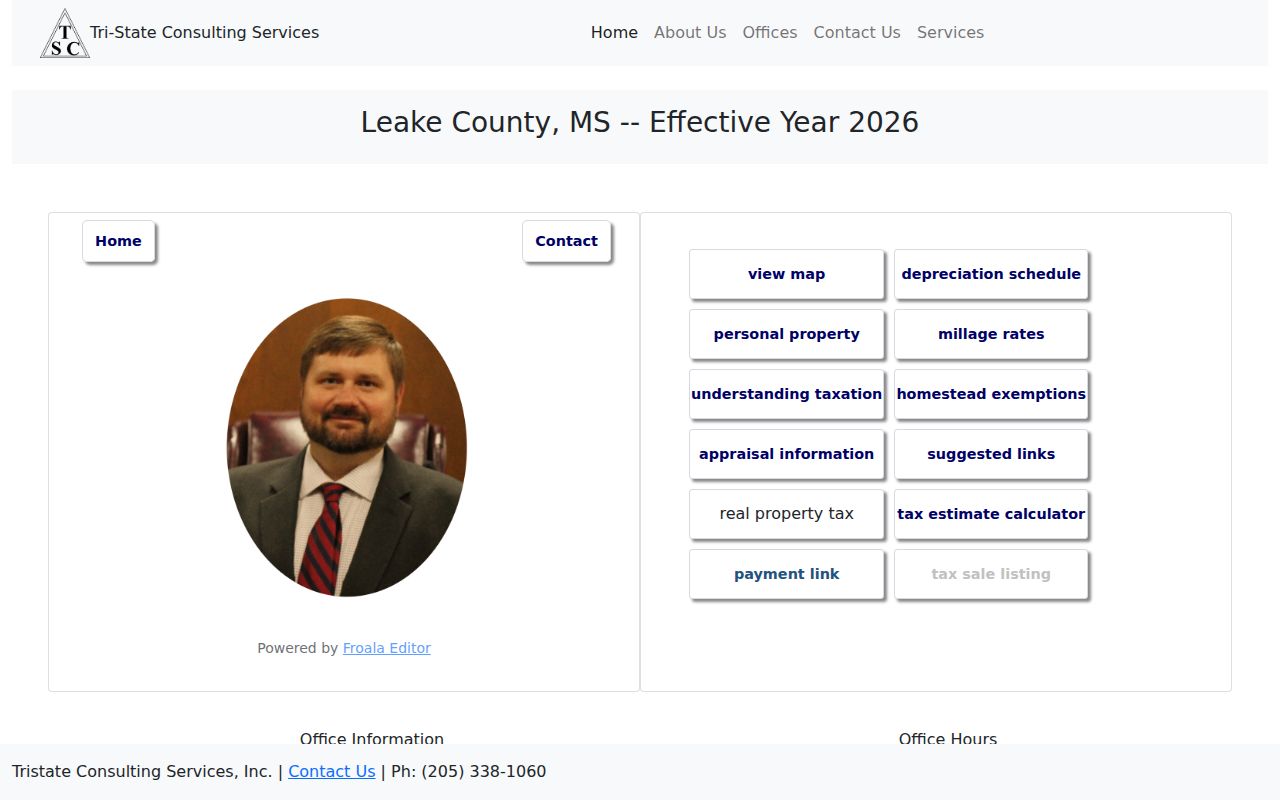
The hub gathers Leake County's tax channels in one screen while leaving each record in its proper role.
Look Up a Leake Tax Bill
The Tri-State real-property search shows PPIN, PARID, owner of record, and tax due. PARID is the parcel identifier the tax system uses. When only an address is known, start with Delta Property Link, then carry that exact parcel key into the bill table.
- Search Property Link by address, owner, parcel, land grid, or PPIN.
- Copy the parcel number and PPIN from the matching result.
- Match PPIN or PARID in the Tri-State tax table before reading tax due.
- Confirm the tax year and account for the January 1 owner rule.
- Call the Collector for an official payoff, receipt, or unclear status.
- Assessed value
- The value after the state ratio.
- Homestead exemption
- Tax relief for qualified applicants under state law.
- Tax lien
- A legal claim tied to unpaid tax.
Leake Tax-Due Screen
The captured Tri-State real-property tax search shows the table before a parcel is chosen.
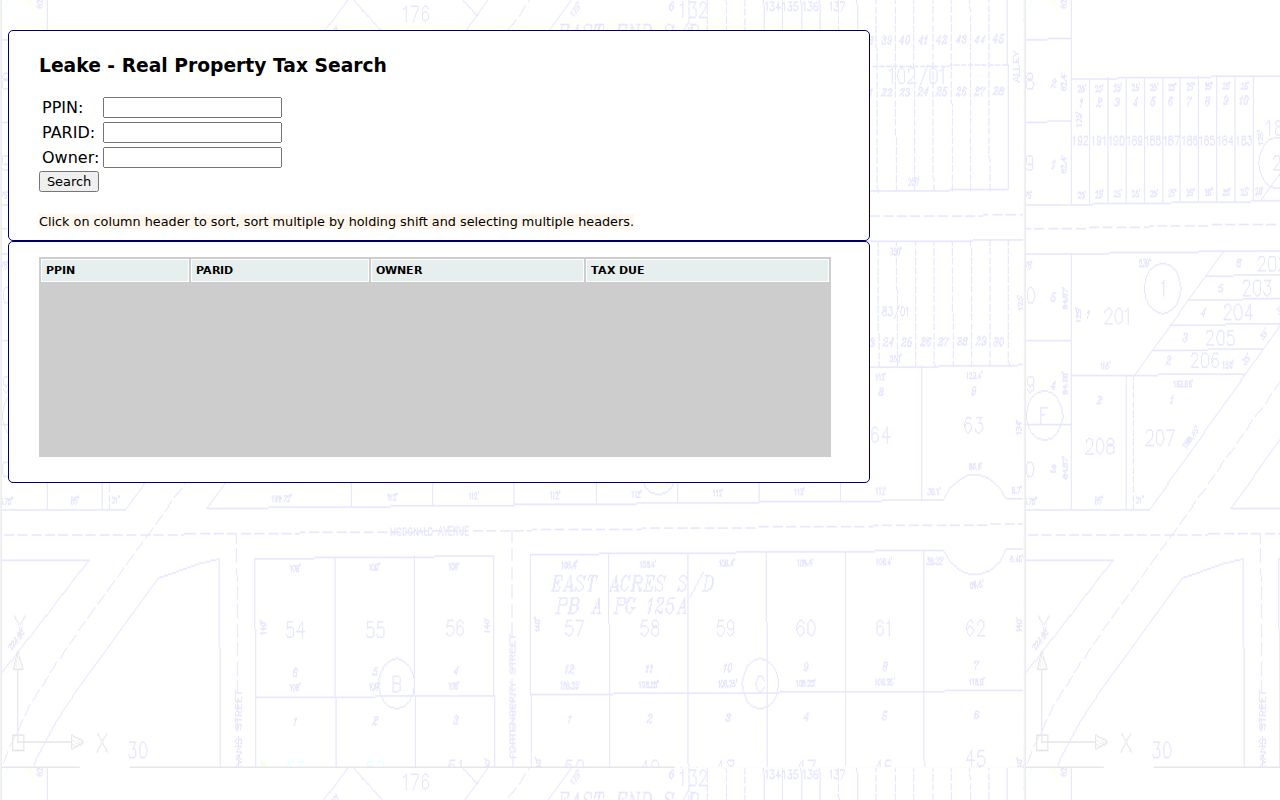
Four columns make the tax-due screen a quick bill-status check. They do not replace the recorded deed or the full assessor record.
Leake Property Tax Calendar
According to the Leake Tax Collector, statements generally go out the week before Thanksgiving or in the first week of December. Taxes are due February 1. Unpaid real property can move toward sale after the last Friday in August. Confirm any time-sensitive status with the Collector. Billing and annual sale activity stay with that office, while the Chancery Clerk handles redemption, notice before foreclosure of redemption rights, and tax deeds after maturity. MDAH holds historic tax-sale books, including an 1872 state-to-J. Wilbanks tax-sale deed it identifies.
Leake Homestead Filing Window
The Mississippi homestead program runs under Mississippi Code §§27-33-1 through 27-33-79. Applications are accepted from January 1 through April 1. State guidance describes tiered treatment and events that can trigger reapplication. Ask the Leake Assessor what proof and local steps apply. Homestead shapes tax treatment; it does not prove title. The deed remains the transfer source.
Leake's January 1 Tax Owner
The name printed on a Leake County tax bill reflects the owner of record on January 1 of that tax year. A deed recorded after that date can sit alongside a tax roll that still shows the prior owner. That gap is normal. It comes from how the annual assessment is frozen, plus a lag as recorded deeds move into the tax system, and Leake County publishes no fixed refresh interval for that upload. To see who truly holds title today, compare the latest deed filed with the Chancery Clerk against the parcel's legal description, the parties named, and the recording date. The tax snapshot never overrides a later transfer recorded in the property records.
Timing tip. A post-January deed may be newer than the owner named in that year's Leake County property tax records.
Contest a Leake Assessment
The Assessor builds the roll. The Board of Supervisors then reviews and adopts it. The Department of Revenue watches valuation at the state level. Leake County publishes no county-specific protest form or fixed appeal window. Call the Assessor at 601-267-3021 when the notice or roll comes out. Ask for the current process, deadline, and hearing details.
Bring the parcel number, PPIN, notice, and a clear property description. Tie your evidence to the disputed value or class. Keep a value appeal separate from a payment question. The Collector cannot substitute for the formal assessment review. Support should address the disputed fact. A wrong class calls for proof of occupancy and use. A factual property error calls for photos, measurements, or records showing the condition on the assessment date.
Comparable sales can support a value concern. Use sales that match the property type and the period. Keep copies of everything filed. Compare the tax roll against the legal owner source too. If the tax name and the newest grantee disagree, note each source date. The recorded deed settles the conveyance. A mismatched parcel key or legal description needs a call to both offices before you assume the Leake County records cover the same land.
Payment questions go straight to the Collector. An online tax-due figure can shift after payment, correction, or sale activity, so ask for a dated receipt or payoff when the amount supports a closing, redemption, or other time-sensitive decision. One parcel can carry several tax histories. Current tax, special assessments, delinquency, redemption, and a mature tax deed do not sit in one row or one office. Start with the Tri-State amount and tax year, then ask the Collector whether payment or sale activity followed. If land sold for taxes, ask Chancery. Request the redemption and tax-deed file there. Historic digging continues through MDAH. Its Leake collection names tax-sale books, lands sold to the state, assessment material, and deed records. A tax sale may explain a sudden new owner in an old chain, so match the tract description and parties before tying the event to a modern parcel.
Confirm the appeal window. Ask the Leake Assessor for the current local deadline before waiting, since no official county schedule was found.
Leake Tax Records by Request
Online tools are not the only door. The Assessor/Collector answers questions by phone and at the Carthage counter. A written request can seek a nonexempt Leake assessment or collection record that no portal shows. Mississippi's Public Records Act opens requests to any person. The office may charge actual search, review, copying, and mailing costs.
Describe the parcel by PPIN, parcel number, owner, and tax year. Say what you want: an assessment card, bill, receipt, delinquency record, exemption record, or tax-sale item. A narrow request speeds the search and the cost estimate. Tax-sale redemptions and tax deeds live with Chancery. Contact that office too for the later steps.
The Act generally requires access within one working day when a public body has no procedure. Written procedures cannot push production past seven working days without an explanation. Fourteen working days is the outer limit absent agreement. Get any denial and cited exemption in writing.
Local assessors set true value, the Board of Supervisors reviews and adopts rolls, and the Department of Revenue reviews county valuation. Local taxing authorities set millage. Statewide DOR data posts county and city millage tables for 2012 through 2025, plus class tables and official contacts. That context cannot replace a current Leake bill. A city mailing name does not settle the taxing district. Carthage, Lena, and Walnut Grove ZIP areas reach beyond municipal limits, so check the parcel's physical boundary before assuming city millage applies. Delinquency needs a dated check. A tax-due column reflects the portal at inspection, while redemption, maturity, and a tax deed follow separate steps. Call the Collector for the amount and sale status. Chancery handles redemption and land-record questions. Preserve the date, PPIN, and source used.