
Trace Back Leake County's Former Owners
The backward chain works like a transfer timeline. It is not a list of every name that resembles a past owner. Start with one confirmed current deed. Record each earlier conveyance as its own row. The Land Title Association describes online Leake land records as 2002-present, while DuProcess accepts earlier dates and its virtual index holds historic books, so treat actual coverage as instrument-dependent.
| Transfer Date | Grantor to Grantee | Deed Type | Book/Page |
|---|---|---|---|
| Newest matched filing | Seller to current grantee | As indexed | Copy exactly |
| Prior acquisition | Earlier seller to that grantor | As indexed | Copy exactly |
| Next earlier transfer | Repeat with the same land | As indexed | Copy exactly |
| Historic-book step | Continue in reverse index | Read instrument | Volume and page |
Dates and parties set the sequence. The legal description sets the continuity. A quitclaim, warranty deed, estate instrument, court order, or tax-sale deed can move a different kind of interest. Preserve the indexed deed type and inspect the document rather than treating every row as a full market sale.
Go Back Through Leake County DuProcess
The DuProcess land inquiry accepts grantor and grantee names, match modes, instrument number, book and page, date, parcel, PPIN, address, and detailed legal criteria. Find the current owner's acquisition as grantee. Read its grantor. Search that grantor as grantee in an earlier period. The parcel or legal description must still match at every repeat.
The begin-date field allows 1/1/1800. Documented Leake deed books begin in the 1830s, so that early date is an interface quirk rather than proof that 1800 records exist. The online 2002 marker, the historic virtual index, and physical or microfilm collections overlap unevenly. Let the visible results decide the next channel. The official grantor-grantee search panel shows the criteria used to reconstruct previous owners.
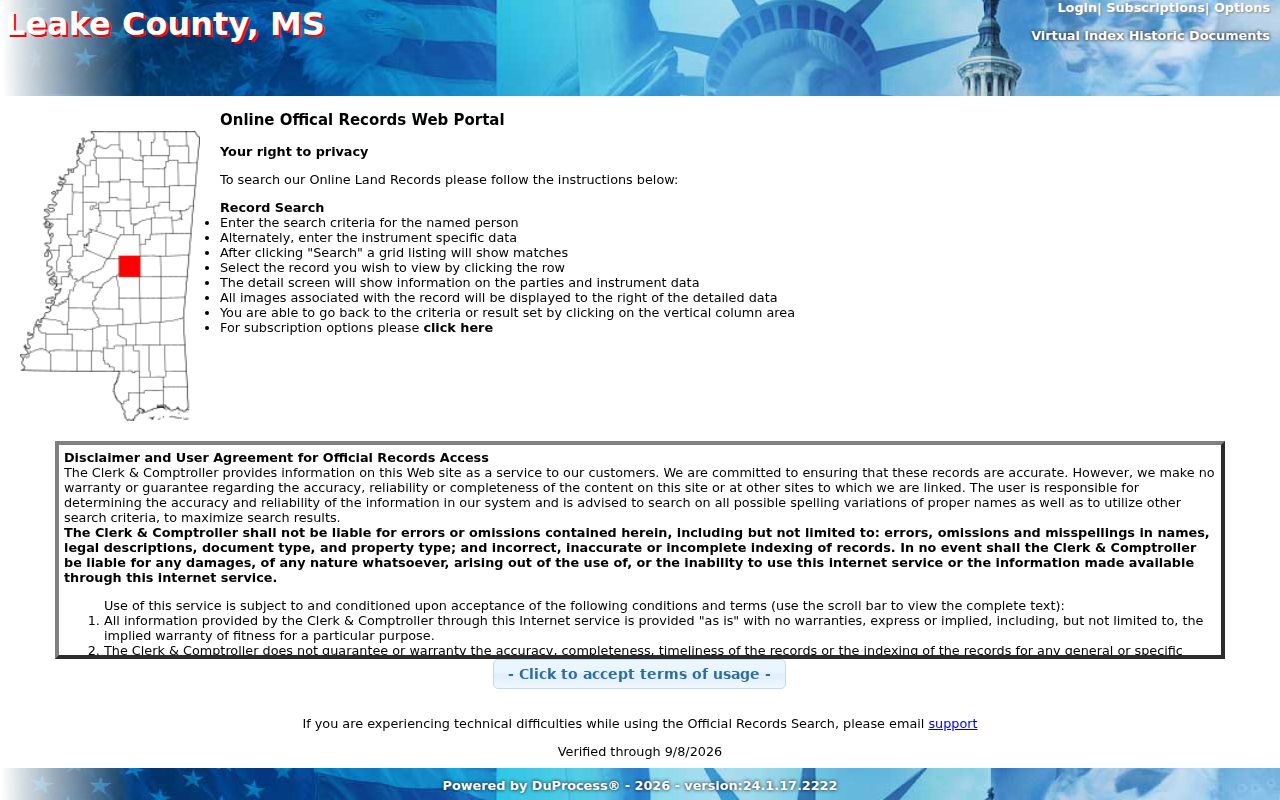
Leake County deed research moves backward one link at a time. Search grantors and grantees separately for each generation. The current owner of record should surface first as a grantee. The party who sold to them is the prior-owner candidate. Confirm the deed matches the same parcel or legal description before trusting the connection. Then hunt that candidate as grantee in an earlier date range. This finds the acquisition before the sale. A matched-name mode cuts spelling noise. Relatives with similar names still demand a land comparison rather than a name match alone.
Keep an exception log next to the transfer table in any Leake County property search. Flag missing images, conflicting spellings, instruments covering several tracts, and deeds conveying only fractional interests. DuProcess offers a notification form for missing instrument details or images. The Chancery Clerk's counter resolves an unclear index entry. When an online search comes up empty, move to another field or access channel. Do not end the historical chain by assumption. Broad criteria help carry the chain through spelling shifts whenever the book and page or the land description is already known.
Reconstruct the Leake County Chain in Reverse
A disciplined worksheet keeps a name search from wandering onto unrelated land. Log the instrument date. Add the recording date, grantor, grantee, deed type, consideration if shown, and the complete legal description. Compare the older deed before adding another former owner.
- Find the newest deed for the subject land and record its grantee.
- Take the grantor from that deed as the next prior-owner candidate.
- Find that grantor's earlier acquisition as a grantee.
- Repeat through the index, then continue in deed books when online results end.
- Grantor and grantee
- The parties conveying and receiving the described interest.
- Chain of title
- The ordered sequence of instruments affecting the same land.
- Reverse index
- An index used to find a prior acquisition by grantee name.
- Quitclaim and warranty deed
- Different conveyance forms whose legal effect must be read from the instrument.
Go Back to Leake County Deed Book A
The Mississippi Department of Archives and History Leake finding aid catalogs Deed Book A for 1834-1837, later deed books running through SS, direct and reverse indexes, and a tract book spanning 1835-1905. That depth of Leake County property records goes well beyond what a current web index guarantees. The Chancery Clerk stays the county land-record custodian. MDAH supplies self-serve microfilm and archive access. The MDAH self-serve inventory lists the named deed, index, tract, and tax-sale collections in one place.
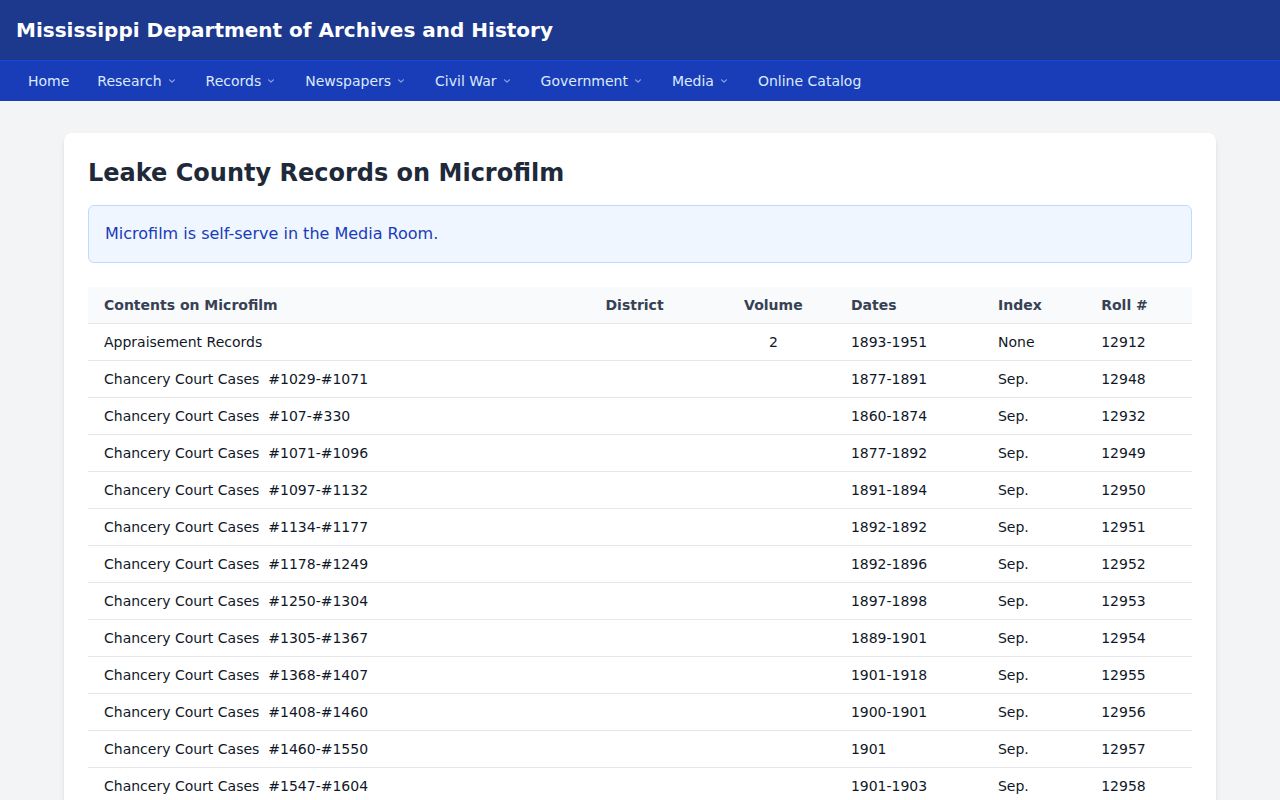
The inventory supplies a documented bridge from an online Leake County deed chain back into nineteenth-century volumes.
Note: No courthouse-fire gap appears in the documented record. Never assume missing years without checking the book and roll inventories themselves.
MDAH's named runs allow a controlled handoff from a modern citation. Direct indexes organize grantors. Reverse indexes organize grantees. Once an online deed yields an older book and page, pull the right microfilm roll. Inspect that page. Then search the earlier grantee entry for the next acquisition in the chain. The 1835-1905 tract book earns its keep when a chain reaches original-entry land. It also helps when family names shift while section, township, and range hold steady.
Mortgage indexes, lis pendens materials, probate and will records round out the collection. None of these series automatically adds a former owner to a Leake County property search. But each can explain why a title history turns stubborn. A mortgage release can clear an encumbrance without conveying ownership. A lis pendens may signal litigation. A will or probate packet may establish succession before any later deed was recorded. Label every event by its true record type. Then the ownership timeline will not treat each indexed filing as a sale.
Recover Leake County Prior Owners From Tax-Sale Records
Some Leake County ownership chains start strangely. A tax sale is often the reason. The sequence may open with the state itself, an unfamiliar entity, or no ordinary seller at all. MDAH identifies Leake Tax Sale Books for 1864 through 1888 and Lands Sold to State records covering 1875 to 1923. One specific example is an 1872 state-to-J. Wilbanks tax-sale deed. Current tax-sale redemption records sit with Chancery functions.
Search the tax-sale and redemption materials before declaring a chain broken, since the former owner may appear in delinquency, sale, patent, or redemption records instead of a warranty-deed sequence. Keep the legal description and dates central. The taxpayer name alone rarely identifies the tract.
A tax-sale path needs more than the sale-book entry. Compare the delinquent taxpayer, the date of sale, the purchaser, the land description, the redemption record, and any later state conveyance. The 1872 Wilbanks deed is a Leake example of a transfer that can make a grantor-grantee chain start abruptly. Redemption tells its own story. If the sale was redeemed, it may not have produced the lasting owner change a simple index list suggests.
Bridge Leake County Estate Gaps in the Owner Chain
Probate can move an interest without any seller-to-buyer pattern. Leake Chancery Court holds probate matters. MDAH's collection runs include probate packets, will records, and related indexes. When a deed chain jumps to heirs, an executor, an administrator, or a trustee, search the estate file first. Then return to the land index for a later distribution or conveyance.
Court orders, partitions, quiet-title matters, and lis pendens can also explain an abrupt change in the former-owner sequence. Modern Leake Circuit Court electronic access began August 12, 2024. Land and probate matters still center in Chancery. Pick the court by case type. A statewide docket is no substitute for land records.
Build the probate bridge carefully. Record the decedent, the estate case, the fiduciary, and the heirs or devisees named in the file, along with the property description and the instrument that returns the parcel to the deed chain. A will expresses an intended gift. The probate orders and later land filings show how that interest was administered and recorded. Where several heirs took undivided shares, a later partition or family conveyance may be needed before the next single-owner entry makes sense.
Inspect Historic Leake County Book and Page Images
The historic virtual index lets researchers browse by record type, book, and page. Display, print, and purchase controls sit alongside the images. Those images are informational only. Official copies must be purchased. A 2018 county FAQ stated deeds were not online, which conflicts with the newer portal and historic image viewer, so verify the exact volume and image needed.
The official historic viewer displays the book and page controls that earlier ownership research relies on.
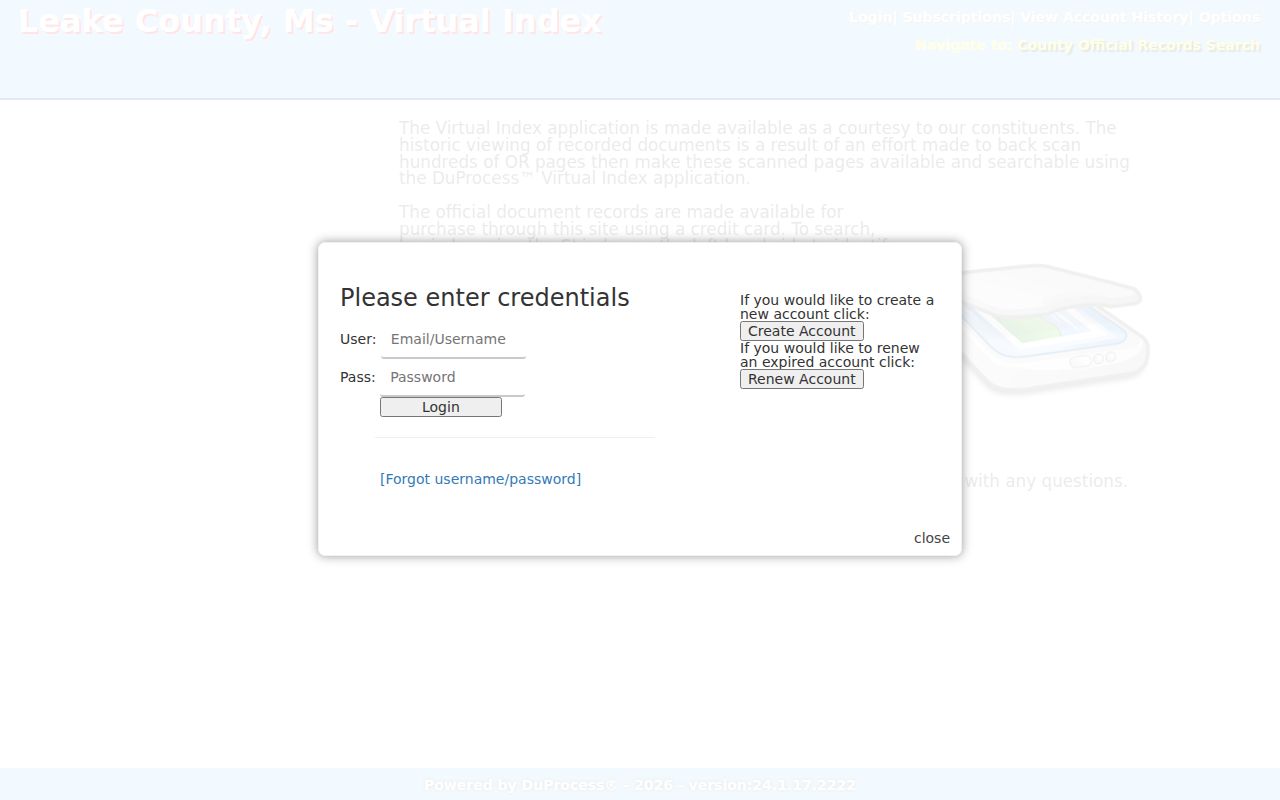
The right book and page make the citation actionable.
Know How Far Back Leake County Former Owners Go
Leake County deed books begin in 1834, one year after the county formed in 1833. The 1835-1905 tract book helps with original-entry research. Later transfers live in the deed indexes and volumes. That does not promise a complete chain for every parcel. Patents, boundary changes, probate, tax sales, and description changes may point to another record series.
Aim for the earliest supported instrument for the same land, not an arbitrary portal date. For the oldest stage, use the Chancery counter, MDAH self-serve microfilm, archive boxes, and the Carthage-Leake County Library Genealogy Room. Record negative searches as carefully as positive ones. Another researcher should be able to retrace the work.
Historic limit. Online results do not define Leake County's full history. Earlier former owners require deed books, indexes, tract books, probate, and tax-sale files.