
Begin a Leake Property Search
A Leake County property search links four sources. Delta Property Link handles the ownership side, with routes for owner, address, parcel number, land grid, and PPIN. The Chancery Clerk's DuProcess index lists recorded instruments and the parties to them. Tri-State supplies tax and map detail. The ArcGIS viewer places the parcel in geographic context.
Start with the fact already in hand. An address is convenient, though an owner name can pull up several tracts. A parcel number or PPIN is the strongest cross-system key, and no portal result equals a title opinion or a legal survey.
- Search Delta Property Link by address, name, parcel, land grid, or PPIN.
- Carry the owner and parcel key to the Chancery deed index.
- Check the Tri-State tax table for the same PPIN or PARID.
- Open the ArcGIS viewer for map context and nearby tracts.
- Request an official copy or use the counter and archives when the web record is incomplete.
Where Leake Records Are Kept
Leake County splits these duties across three offices. The Chancery Clerk records conveyances and liens. The Tax Assessor values and classifies parcels and maintains the ownership maps, while the Tax Collector bills, collects, and handles delinquent-tax sale work. Each office offers phone, counter, and written request options as fallbacks.
Leake County Chancery Clerk
101 Court Square, P.O. Box 72
Carthage, MS 39051
601-267-7371
Delta Links Leake Parcels
Property Link exposes five exact routes. They are Name, Address, Parcel Number, Section/Township/Range, and PPIN. City and ZIP lack separate first-screen fields. That gap makes the land-grid route the choice for rural tracts and the PPIN the key for moving among tax, map, and recorder records.
| Search field | Best clue | Risk |
|---|---|---|
| Name | Known owner | Same names and entities |
| Address | Known site | Mailing city or old road |
| Parcel or PPIN | Exact tract | Missing from some old deeds |
| Section/township/range | Rural legal location | Needs careful transcription |
Delta says data is uploaded often but may lag courthouse work. The tax statement also carries the owner as of January 1, so a later deed can be newer than the tax owner.
The captured Delta search screen shows those fields.
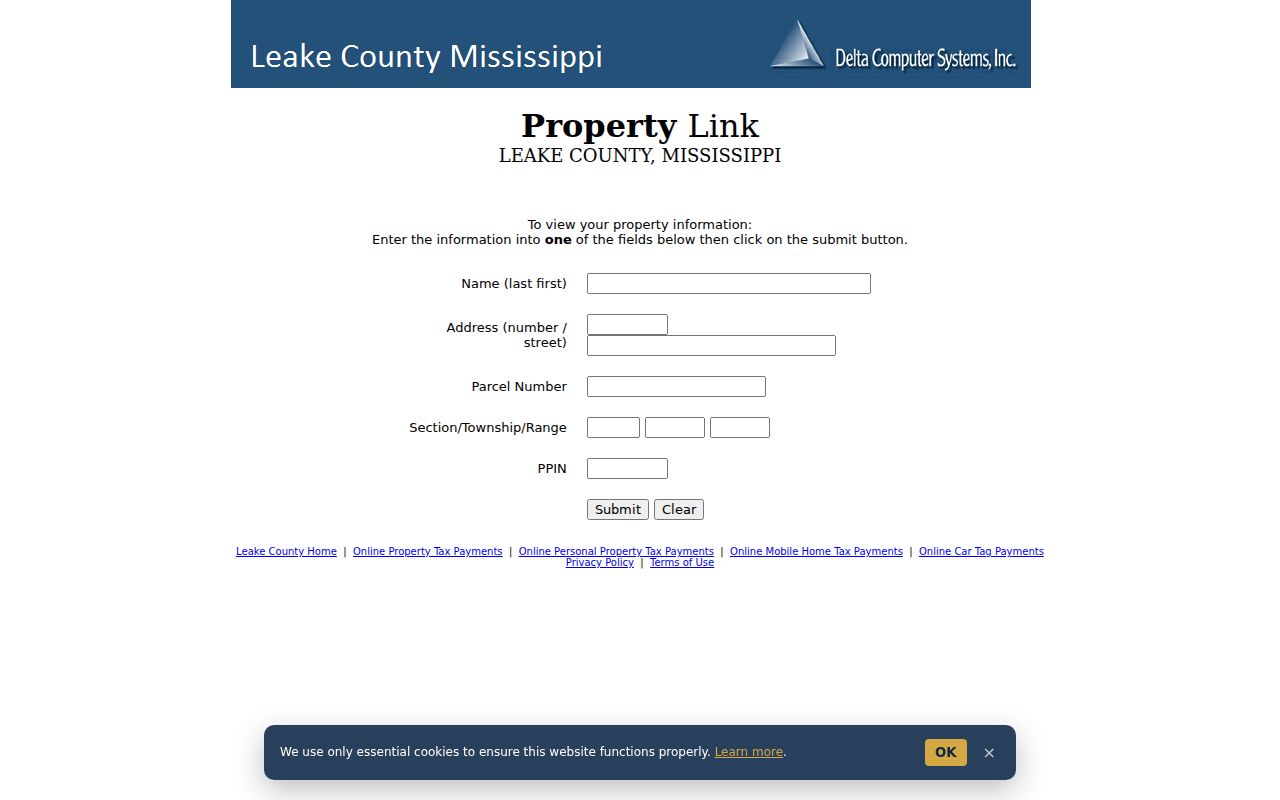
The field mix reflects Leake County's blend of street-address parcels and rural land descriptions.
Leake Deeds and Indexing
The Chancery Clerk records the county's land papers. Warranty deeds, deeds of trust, powers of attorney, plats, lis pendens, construction liens, and federal tax liens all pass through the office. Related filings do too. The DuProcess index searches those records by grantor, grantee, dates, book and page, and instrument number. It also searches by street, legal description, subdivision, lot, block, parcel, PPIN, and more.
A grantor conveys the interest. A grantee receives it. The index itself cautions that misspellings, incomplete legal descriptions, and document-type errors can occur. So search each name in both roles. Use the legal description to keep the parcel steady. For a focused chain and copy workflow, see the Leake County deed records page.
Leake GIS Parcel Context
The public ArcGIS experience is the county map route from the Tri-State hub. A statewide cadastral service tags LEAKE_PARCELS as layer 60. It supports common service queries and geographic output formats. The viewer places a tax parcel against roads, aerial imagery, and neighboring polygons, though no public buffer or select-by-location control is offered, and the full layer list and exact PPIN format stay unpublished. Map lines serve as administrative reference only. They are not a boundary survey. A deed, a plat, and a licensed survey settle the legal questions.
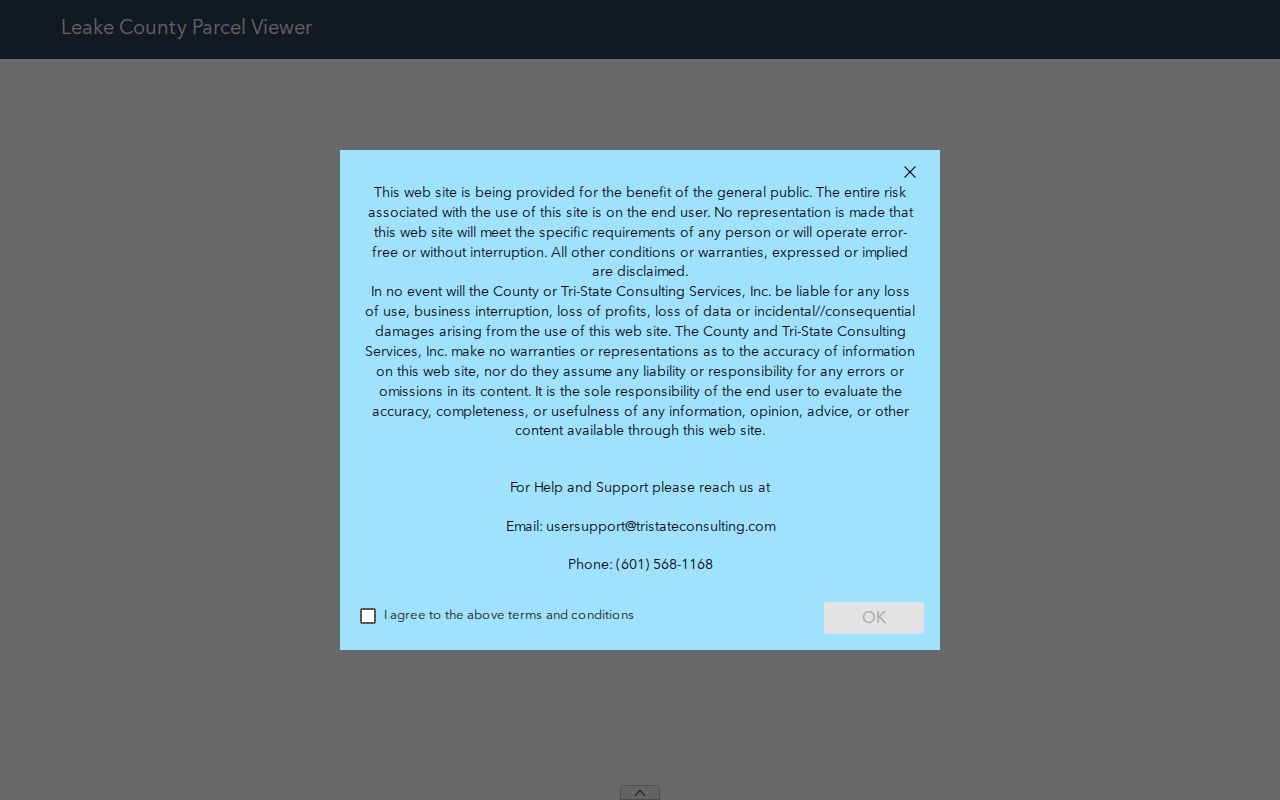
The map adds place to the record trail without replacing the legal description.
Leake Property Record Types
Each record set answers one part of a parcel question. Start with the source built for that fact. Then confirm the parcel's key identities in a second source before trusting any single tax owner, map line, or index entry.
| Record Type | What It Documents | Kept By | Access |
|---|---|---|---|
| Deeds | Conveyances, parties, legal descriptions | Chancery Clerk | DuProcess, counter, mail |
| Liens and trusts | Recorded claims and secured interests | Chancery Clerk and SOS UCC | Index, office, state search |
| Assessment and tax | Owner snapshot, value, class, exemption, tax due | Assessor/Collector | Delta, Tri-State, office |
| Plats and parcels | Lot/block, land-grid and map context | Chancery, GIS, MDAH | Viewer, books, microfilm |
| Court and probate | Quiet title, partition, estate, redemption | Chancery or Circuit Clerk | PAMEC, terminals, requests |
Recorded ownership comes from the deed chain. Tax amounts and exemptions come from the Assessor and Collector. A map adds location, a plat or survey fixes the legal geometry, and court or estate files can explain transfers a simple warranty-deed chain misses.
Leake Tax Timing and Value
The Tri-State tax table lists PPIN, PARID, owner, and tax due. The hub posts effective year 2026. Mississippi assesses Class I owner-occupied residential real property at 10 percent of true value. Class II other real property is assessed at 15 percent. Real property is revalued at least every four years.
Leake property taxes come due February 1. Statements generally go out before Thanksgiving or in early December. Unpaid property may move toward sale after the last Friday in August. The January 1 owner rule explains why a new grantee can appear in Chancery deed records first. The tax statement changes later.
Historic Leake Books Begin 1834
Older Leake County deed records survive in deep runs of books. The MDAH Leake finding aid reaches back to Deed Book A, covering 1834 through 1837. It also catalogs later deed books and indexes. The holdings span a tract book covering 1835 to 1905, mortgages, tax-sale books, lands sold to the state, probate files, wills, and lis pendens. When the current portal runs dry, this microfilm collection is the main fallback.
A land-title association places online land records at 2002 forward. Yet DuProcess accepts a start date of 1800. A separate Virtual Index serves up scanned historic books. A typed date range is not proof of full coverage. Always confirm the exact book and page image. The county FAQ's older claim was that deeds are not online. That claim now sits stale beside these live tools.
The MDAH finding aid names each microfilm run.
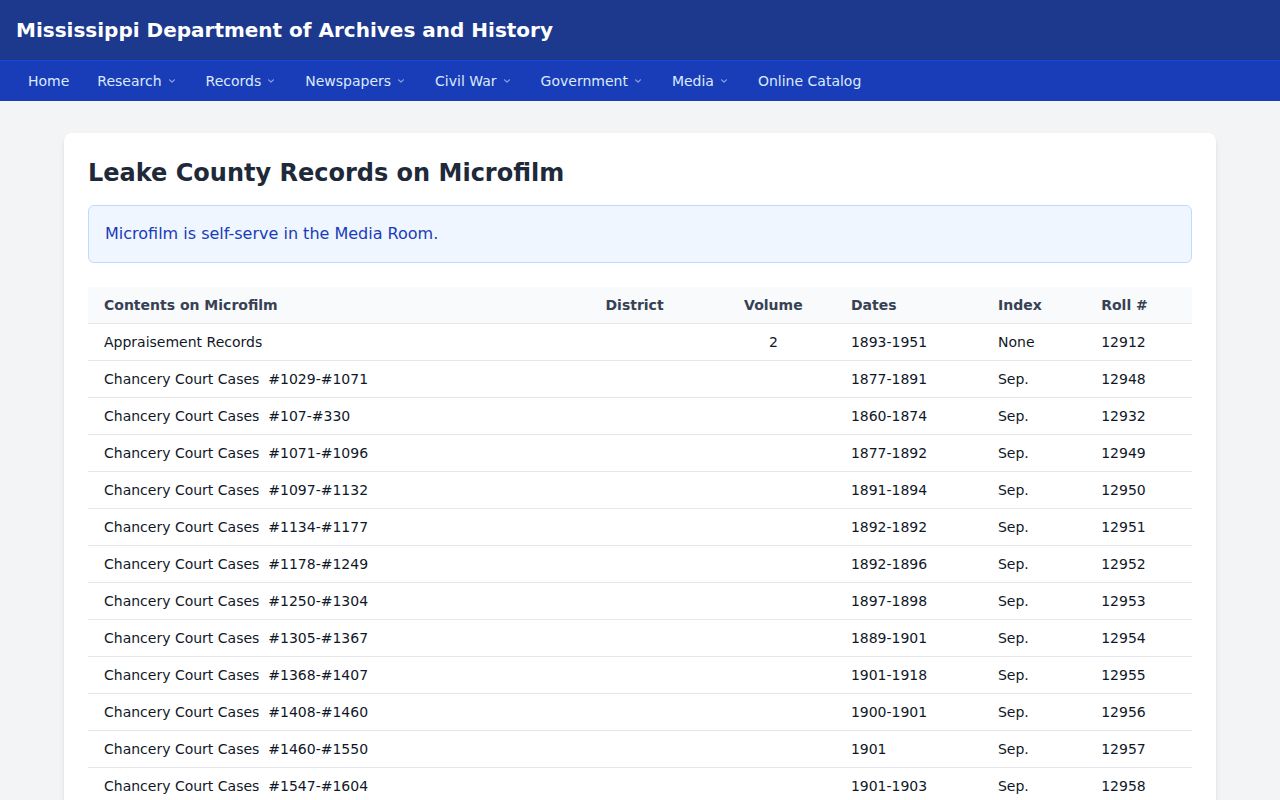
Named books, rolls, and dates make this archive work.
Leake Liens and Court Files
Deeds of trust, construction liens, federal tax liens, UCC releases, and lis pendens all move through DuProcess. That is the system Leake County uses. A lis pendens warns that pending litigation may affect a piece of land. Search by property owner, borrower, grantor, parcel, or legal description. Then look for releases and assignments. Also check any related instruments that might clear or transfer the claim. The type of dispute usually tells you where the file lives. Partitions, quiet-title cases, probate, and tax redemption tend to sit in Chancery Court. Circuit and County Court judgments stay with the Circuit Clerk. Leake Circuit Court joined MEC on August 12, 2024. That gives the public a PAMEC route into modern docket data. Older or non-electronic files may still need a terminal visit or a request to the clerk.
Leake Public Records Requests
The Mississippi Public Records Act of 1983 is Title 25, Chapter 61. It gives any person the right to request nonexempt records. When a public body has no written procedure, access is due within one working day. A procedure cannot push production past seven working days without a written explanation. Absent an agreement, fourteen working days is the ordinary outer limit. Fees can cover actual search, review, copying, and mailing costs. An office may collect them in advance. A denial should cite the exemption claimed. Where possible, nonexempt parts must be separated out and released.
For property material that is not online, describe the parcel, owner, legal description, record type, and date range. Do not request every file under a broad name. Ask for an existing record, not a title search. No office is obligated to perform that work for you.
Access channels differ by office. Chancery offers the current index and a historic book viewer. It also offers card purchase controls, counter service, phone, and mail. The Assessor/Collector provides Delta and Tri-State along with phone and counter help. Historic books run through MDAH microfilm and archive requests. Local genealogy rooms can also connect old names and roads to county sources. Include a return address and preferred format in any request. Ask for a cost estimate when the work looks large. If part of a record is exempt, request the nonexempt portion. Keep the response date and the custodian's name with your property notes.
Leake City and ZIP Limits
Carthage, Lena, and Walnut Grove are the incorporated places. Their postal names reach past the legal city limits. ZIP codes 39051, 39094, and 39189 describe mail geography, not boundaries. This matters for zoning and permits. The county hazard plan states that Leake County has no countywide zoning or subdivision ordinance. Carthage, by contrast, has both.
Check the parcel viewer and a city boundary source before picking a permit office. Walnut Grove runs permits and inspections through its Planning/Zoning process. Carthage publishes a zoning map and a public-record request form. Lena offers no online property or permit index. Direct requests to the town remain the fallback there.
Limits of Leake Property Records
What Leake County property records can and cannot do. Leake County property records can identify assessed owners, recorded parties, legal descriptions, tax status, values, parcel context, and public court events. They cannot guarantee clear title, fix a legal boundary, prove who occupies a home, or state a sale-ready market price. A certified document authenticates the copy, not the whole title chain.
Mississippi law also protects specific information. Vital records are restricted, some addresses may be confidential under the state Address Confidentiality Program, and sensitive identifiers should never be repeated from old images. Public access does not authorize targeting or harm.
Probate and estate transfers deserve a separate check. The Chancery Clerk holds probate and equity files, while MDAH lists probate minutes and wills beside the historic land books. An executor, administrator, heir, or trust may appear in the record trail without an ordinary sale. Match the estate case to the same legal description before treating it as part of the parcel chain.
Tax-sale history can also break a neat deed sequence. MDAH lists Tax Sale Books from 1864-1888 and Lands Sold to State from 1875-1923, while current Chancery staff handle redemption and tax deeds. Its finding aid identifies an 1872 state-to-J. Wilbanks tax-sale deed. That record is a local example of how state ownership and redemption can enter a land history.
Current public-work notices may create new parcel context. Leake County posted 2025 bid notices for Sistrunk Road, Massey Road, and Industrial Park site preparation. Those notices do not change title by themselves. They can point toward plans, specifications, access work, or later plats worth checking for nearby land.
No property-fraud alert signup exists for Leake County. Monitor by searching the Chancery owner and parcel, opening unfamiliar instruments, and calling the Clerk. DuProcess has a notification form for missing details or images, but it is not a fraud-alert subscription. Suspected false filings should be preserved and reported through the Clerk and proper law-enforcement channels.
The state Address Confidentiality Program under Mississippi Code §99-47-1 gives qualified victims a substitute address and mail forwarding. Its confidential address and program file are exempt with limited exceptions. A participant should contact the program, Assessor, and Chancery Clerk rather than assume that ordinary land and tax fields will change on their own.
Recorded documents should not include sensitive identifiers unless law requires them. Mississippi Code §89-5-24 sets recording-format rules and calls for title, return address, legal description or indexing instruction, and one-sided pages for covered instruments. Historic images can still contain data that should not be copied into a request or republished.
Official sources work better together than commercial data summaries. Delta gives the assessed owner and parcel key. Tri-State adds tax due. ArcGIS adds map context. DuProcess supplies recorded parties and instruments. None alone provides a complete title examination, yet their agreement can establish a sound starting identity for lawful due diligence.
House and land history can continue beyond courthouse indexes. The Carthage-Leake County Library Genealogy Room lists phone 601-267-7821 and a local email contact. Walnut Grove also has a documented genealogy and history room. Mississippi State University Libraries points to Leake cemetery, Reconstruction, and 1835 tax-list sources. These collections can connect a family, cemetery, or old place name to the parcel trail, but the deed and probate books remain the proof source.
The county record trail begins early. Leake County was formed in 1833, Carthage was selected as the county seat in 1834, and the first courthouse was built in 1836. A later brick courthouse and the 1910 courthouse mark changes in the civic setting, while the core deed run remains documented from the 1830s. No authoritative source reports a fire or flood that destroyed that run.
Recorded consideration also needs care. DuProcess can search a minimum and maximum consideration value and may show the amount on a record detail. That figure can support transfer research, yet it is not the assessor's true value, assessed value, or current sale estimate. Use the county tax framework for assessment and the instrument for what it records.
For estate and heir research, a death record is not an ordinary open land record. Mississippi vital-record access requires a legitimate direct and tangible interest under §41-57-2 and state rules. Chancery probate files, recorded executor deeds, wills in the historic collection, and the deed index are the property-facing route. Use a restricted vital record only through its lawful eligibility process.
Note: Match names, dates, and land descriptions before relying on any result.
Lawful use. Use Leake records for deeds, boundaries, tax review, estate work, and civic research. Never use owner information to stalk, harass, or harm a person.